
Noorani Qaida: Read Online & Free PDF Download (with English)
The complete Noorani Qaida in 17 lessons, from the Arabic alphabet to reading the Quran, with clear English instructions. Read every lesson online, download the free PDF, or learn it with a qualified teacher.
- Free PDF in colour and black & white
- All 17 lessons readable online
- Free 3-day trial with a live tutor
Learn Noorani Qaida with a tutor
Tell us a little about the learner. We'll reply to arrange a time for the trial classes.
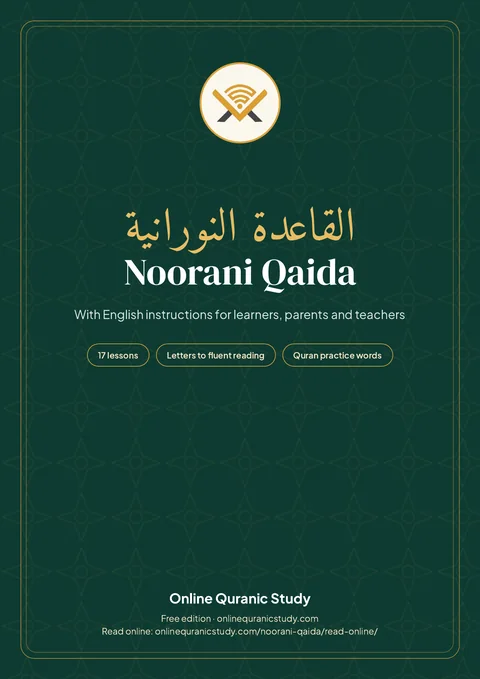
Download the Noorani Qaida PDF free
Our edition of the Noorani Qaida (Al-Qāʿidah An-Nūrāniyyah) is freshly typeset in a clear Quranic font, with English instructions and a teaching tip in every lesson, letter names in English, and practice words taken word for word from the Quran. It is free to print and share for personal and teaching use.
- 31 pages, A4, 17 lessons plus the key reading rules
- Colour edition for screens and tablets
- Black & white edition that prints cleanly at home or school
- No sign-up needed
What is the Noorani Qaida?
The Noorani Qaida (also written Noorani Qaidah, Qaida Noorania, Nurani Qaida or Qurani Qaida) is the most widely used first book for learning to read the Quran. In Arabic it is called القاعدة النورانية, Al-Qāʿidah An-Nūrāniyyah. The word qaidah means "foundation" or "rule", and that is exactly what the book is: the foundation of Quran reading. In many homes it is simply called "the qaida" or "kaida".
It was compiled by Sheikh Noor Muhammad Haqqani of Ludhiana, in the Punjab, and it carries his name: Noorani, from Noor. Its strength is its order. Instead of teaching letters and then throwing the learner into the Quran, it adds one new idea at a time (a vowel, a sign, a rule) and practises it before moving on. By the last lesson, the learner has met every sign they will see in the mushaf.
Generations of children in Pakistan, India, Bangladesh, the Arab world and Muslim communities in the UK, USA and beyond have started with it, and it works just as well for adults and new Muslims starting from zero.
How many lessons, pages and takhti are in the Noorani Qaida?
Most editions have 16 or 17 lessons. In Urdu each lesson is called a takhti (the name of the wooden board children once wrote on), so "how many takhti" and "how many lessons" mean the same thing. Some editions combine madd and leen in one lesson, which gives 16; ours keeps them separate, which gives 17. Printed editions usually run to roughly 30 to 40 pages; our PDF has 31 A4 pages.
| Lesson | What it teaches | Arabic name |
|---|---|---|
| Lesson 1 | Single Letters (Huroof Mufradat) | الحروف المفردة |
| Lesson 2 | Joined Letters (Huroof Murakkabat) | الحروف المركبة |
| Lesson 3 | Disjointed Letters (Huroof Muqattaʿat) | الحروف المقطعات |
| Lesson 4 | Short Vowels (Harakaat) | الحركات |
| Lesson 5 | Double Vowels (Tanween) | التنوين |
| Lesson 6 | Practice: Harakaat and Tanween (Mashq) | تمرين الحركات والتنوين |
| Lesson 7 | Standing Vowels (Khari Zabar, Khari Zer, Ulta Pesh) | الحركات القائمة |
| Lesson 8 | Madd Letters (Huroof Madd) | حروف المد |
| Lesson 9 | Leen Letters (Huroof Leen) | حروف اللين |
| Lesson 10 | Practice: Madd and Leen (Mashq) | تمرين المد واللين |
| Lesson 11 | Sukoon (Jazm) | السكون |
| Lesson 12 | Practice: Sukoon (Mashq) | تمرين السكون |
| Lesson 13 | Shaddah (Tashdeed) | التشديد |
| Lesson 14 | Practice: Shaddah (Mashq) | تمرين التشديد |
| Lesson 15 | Shaddah with Sukoon (Mashq) | التشديد مع السكون |
| Lesson 16 | Two Shaddahs (Tashdeed with Tashdeed) | تشديد مع تشديد |
| Lesson 17 | Shaddah after a Madd Letter (Tashdeed baʿd Huroof Madd) | التشديد بعد حروف المد |
The Noorani Qaida lesson by lesson
Here is what each lesson covers, with a few examples. Every lesson is also on its own page, so you can read the Noorani Qaida online lesson by lesson, from Lesson 1 to Lesson 17.
Noorani Qaida Lesson 1: Single Letters (Huroof Mufradat)
The 29 letters of the Arabic alphabet, read from right to left. Learn each letter's name and its correct sound from your teacher. Many letters have sounds that do not exist in English, so listen closely and copy the exact sound.
ا ب ت ث ج حRead Lesson 1 online →
Noorani Qaida Lesson 2: Joined Letters (Huroof Murakkabat)
Arabic letters change shape when they join. Most letters connect on both sides; six letters (ا د ذ ر ز و) never join to the letter after them. Learn to recognise each letter in every position.
ا ا ـا ـاRead Lesson 2 online →
Noorani Qaida Lesson 3: Disjointed Letters (Huroof Muqattaʿat)
Some surahs begin with letters that are read by their names, letter by letter. They appear at the start of 29 surahs in 14 different combinations. Read each letter's name, and stretch the letters your teacher shows you.
الٓمٓ الٓمٓصٓ الٓر الٓمٓر كٓهيعٓصٓ طهRead Lesson 3 online →
Noorani Qaida Lesson 4: Short Vowels (Harakaat)
Three short vowel marks: Fatha ( ـَ ) a short 'a' sound, written above the letter; Kasra ( ـِ ) a short 'i' sound, written below; Damma ( ـُ ) a short 'u' sound, written above. Read each one quickly and crisply, without stretching.
اَ اِ اُ بَ بِ بُRead Lesson 4 online →
Noorani Qaida Lesson 5: Double Vowels (Tanween)
Tanween is a doubled vowel mark that adds an 'n' sound: ـً 'an', ـٍ 'in', ـٌ 'un'. Fathatan is usually written with an extra alif after it, which is not read.
اً اٍ اٌ بًا بٍ بٌRead Lesson 5 online →
Noorani Qaida Lesson 6: Practice: Harakaat and Tanween (Mashq)
Real words from the Quran that use only short vowels and tanween. Read each word letter by letter first, then join the sounds smoothly.
مِنَ هُوَ وَهُوَ هُمُ عَنِ لَكَRead Lesson 6 online →
Noorani Qaida Lesson 7: Standing Vowels (Khari Zabar, Khari Zer, Ulta Pesh)
A standing fatha ( ـٰ ), standing kasra ( ـٖ ) and inverted damma ( ـٗ ) are long vowels: read them for two counts, twice as long as a short vowel.
بٰ بٖ بٗ تٰ تٖ تٗRead Lesson 7 online →
Noorani Qaida Lesson 8: Madd Letters (Huroof Madd)
The three madd (long vowel) letters stretch the sound to two counts: alif after a fatha ( ـَا ), yaa after a kasra ( ـِي ), and waw after a damma ( ـُو ). The madd letter itself has no mark.
بَا بِي بُو تَا تِي تُوRead Lesson 8 online →
Noorani Qaida Lesson 9: Leen Letters (Huroof Leen)
Waw or yaa with a sukoon, after a letter with a fatha, are read softly: 'aw' and 'ay', as in بَيْ (bay) and بَوْ (baw). Do not stretch them in normal reading.
بَيْ بَوْ تَيْ تَوْ ثَيْ ثَوْRead Lesson 9 online →
Noorani Qaida Lesson 10: Practice: Madd and Leen (Mashq)
Quran words with madd letters. Stretch every madd letter for two counts and keep the short vowels short.
مَا لَا وَلَا وَمَا قَالَ كَانَRead Lesson 10 online →
Noorani Qaida Lesson 11: Sukoon (Jazm)
A sukoon ( ـْ ) means the letter has no vowel. It joins to the letter before it: اَبْ is 'ab'. The qalqalah letters (ق ط ب ج د) echo slightly when they have a sukoon.
اَبْ اِبْ اُبْ اَتْ اِتْ اُتْRead Lesson 11 online →
Noorani Qaida Lesson 12: Practice: Sukoon (Mashq)
Quran words with sukoon. The word ٱلْ at the start of a word is the Arabic 'the'; when you start reading from it, say 'al'.
أَوْ مِنْ ٱلْأَرْضِ قُلْ لَهُمْ شَىْءٍRead Lesson 12 online →
Noorani Qaida Lesson 13: Shaddah (Tashdeed)
A shaddah ( ـّ ) doubles the letter: read it twice, first with a sukoon (joined to the letter before), then with its vowel. اَبَّ is 'ab-ba'.
اَبَّ اِبِّ اُبُّ اَتَّ اِتِّ اُتُّRead Lesson 13 online →
Noorani Qaida Lesson 14: Practice: Shaddah (Mashq)
Quran words with one shaddah. In ٱلَّ, ٱلنَّ, ٱلرَّ and similar words the laam is not read, and the next letter is doubled (a 'sun letter').
ٱللَّهِ ٱلَّذِينَ ٱللَّهُ إِنَّ ٱللَّهَ إِلَّاRead Lesson 14 online →
Noorani Qaida Lesson 15: Shaddah with Sukoon (Mashq)
Words that combine a shaddah and a sukoon. Read slowly and give every silent and doubled letter its right.
ٱلدُّنْيَا رَبِّهِمْ إِنَّهُمْ لَعَلَّكُمْ ٱلْحَقُّ ٱلْحَقِّRead Lesson 15 online →
Noorani Qaida Lesson 16: Two Shaddahs (Tashdeed with Tashdeed)
Words with two doubled letters. Double each one fully, and hold the ghunnah on a doubled ن or م.
ٱلنَّبِىُّ ٱلنَّبِىِّ ٱلظَّنَّ يَذَّكَّرُونَ ٱلتَّوَّابُ ٱلضُّرُّRead Lesson 16 online →
Noorani Qaida Lesson 17: Shaddah after a Madd Letter (Tashdeed baʿd Huroof Madd)
When a madd letter is followed by a shaddah in the same word, the madd is stretched for six counts (madd lāzim). The wavy mark ( ـٓ ) shows the long stretch.
دَآبَّةٍ ٱلضَّآلِّينَ جَآنٌّ كَآفَّةً ٱلضَّآلُّونَ ٱلْحَآقَّةُRead Lesson 17 online →
Noorani Qaida in English
Most Noorani Qaida books are printed with instructions in Urdu, which leaves many families in the UK, USA, Canada and Australia stuck: the child can't read the instructions, and often neither can the parent. Our English Noorani Qaida explains every lesson in plain English, gives the English names of the letters, and adds a teaching tip so a parent can follow along.
What it does not do is write the Arabic in English letters. Transliteration seems easier at first, but English letters can't show sounds like ع, ح, ق or ض, and learners who rely on it carry the mistakes for years. The English is there to explain; the reading is always from the Arabic.
How to learn the Noorani Qaida (step by step)
- Start at Lesson 1, even if you know some letters. Placement mistakes are the most common reason learners stall later.
- Learn each sound from a teacher. Listen, repeat and get corrected. This is the one part a PDF or app can't do for you.
- Read right to left, row by row, starting from the top right of each grid.
- Practise 15 to 30 minutes a day. Short daily practice beats a long weekly session.
- Revise before you move on. Read the previous lesson once before each new one.
- Move to the next lesson only when this one is easy: no prompting, no guessing, few mistakes.
If you're learning as an adult, see our Quran classes for adults; for a wider plan, read how to learn Quran online.
How to teach the Noorani Qaida to kids
Most children are ready to begin between about four and six, once they can sit and focus for 15 to 20 minutes (see what age to start). Keep lessons short and lively, praise effort, and finish while the child still wants more. Point to each letter as it is read, so the eyes and the sound stay together, and ask the child to "spell" new words aloud (meem-kasra mi, noon-fatha na: مِنَ) before reading them in one go.
If you don't read Arabic yourself, you can still help a great deal: sit with your child, keep the daily routine, and ask the teacher what to practise. Our female Quran teachers are a popular choice for young children and girls. More ideas are in our guide to a Quran routine at home.
How long does the Noorani Qaida take?
It depends on age, how many lessons a week, and practice at home. These are typical ranges, not promises:
| Learner | Lessons per week | Typical time to finish |
|---|---|---|
| Young child (4–7) | 3–5 short lessons | Around 4–8 months |
| Older child (8–12) | 3–5 lessons | Around 3–6 months |
| Teen or adult | 3–5 lessons | Around 2–4 months |
The slowest part is usually Lessons 1 and 2, while the learner gets used to new sounds and shapes. After that, progress speeds up.
What is the difference between Noorani Qaida and Madani Qaida?
Both are beginner primers that lead to the same goal: reading the Quran correctly. The Noorani Qaida is the older and more widespread book, organised around the signs of the Arabic script (letters, vowels, madd, sukoon, shaddah). The Madani Qaida is a separate primer, widely used in Pakistan and in Dawat-e-Islami's Madrasa-tul-Madina classes, which arranges the lessons differently and puts more emphasis on makhārij (where each letter is pronounced) and tajweed terms from the start. A learner can succeed with either; what matters far more is having a teacher who corrects you. If your child has already started one, there is no need to switch.
What comes after the Noorani Qaida?
Once the Qaida is fluent, learners move to reading the Quran itself, usually starting with the short surahs of Juz ʿAmma, then on through the mushaf. Alongside that come Tajweed rules (the rules at the end of our PDF are a first taste), then memorization and understanding the meaning. See our Quran reading classes for the next step.
Learn the Noorani Qaida with a qualified teacher
Read this Qaida with a live, one-to-one tutor who hears every letter and corrects it. Male and female tutors, lessons at times that suit you in the UK, USA, UAE, Canada, Australia or Qatar, and plans from $29 a month after a free 3-day trial.
Noorani Qaida FAQs
What is Noorani Qaida?
The Noorani Qaida (Al-Qāʿidah An-Nūrāniyyah) is a beginner's book for learning to read the Quran in Arabic. It teaches the letters, joined letters, vowel marks, tanween, madd, sukoon and shaddah in a fixed order, with practice from Quran words.
Who wrote the Noorani Qaida?
It was compiled by Sheikh Noor Muhammad Haqqani of Ludhiana in the Punjab, and is named after him (Noorani, from Noor).
How many lessons are in the Noorani Qaida?
Most editions have 16 or 17 lessons. Our English edition has 17 lessons plus a page of key reading rules.
How many takhti are in the Noorani Qaida?
Takhti is the Urdu word used for each lesson, so the answer is the same: usually 16 or 17 takhti, depending on the edition.
How many pages does the Noorani Qaida have?
Printed editions usually have roughly 30 to 40 pages. Our free PDF has 31 A4 pages.
Can I download the Noorani Qaida PDF for free?
Yes. Our Noorani Qaida PDF is free to download, print and share for personal and teaching use, in colour or in black and white. You can also read every lesson online.
Is there a Noorani Qaida in English?
Yes. Our edition explains every lesson in English, gives the English letter names and includes a teaching tip, while all reading is from the Arabic script.
How long does it take to finish the Noorani Qaida?
Typically a few months with three to five lessons a week: around 4–8 months for young children, 3–6 months for older children and 2–4 months for adults. Practice at home makes the biggest difference.
What age should a child start the Noorani Qaida?
Many children start between about four and six, once they can focus for 15 to 20 minutes. Adults can start at any age.
What comes after the Noorani Qaida?
Reading the Quran itself, usually starting with the short surahs of Juz ʿAmma, together with Tajweed rules. Memorization and understanding the meaning can follow.
What is the difference between Noorani Qaida and Madani Qaida?
Both are beginner primers. The Noorani Qaida is organised around the signs of the Arabic script; the Madani Qaida, widely used in Pakistan, arranges the lessons differently with more early focus on makharij and tajweed terms. Either works with a good teacher.
Can I learn the Noorani Qaida online?
Yes. In live one-to-one online classes the teacher shares the Qaida on screen, listens to every letter and corrects you. Online Quranic Study offers a free 3-day trial with male and female tutors.
Start the Noorani Qaida with a teacher this week
Three free trial classes with a qualified male or female tutor. We'll check the learner's level and start from the right lesson.