
How to Learn Quran Online: A Step-by-Step Guide for Kids, Adults and Beginners
By the Online Quranic Study team ·
Millions of Muslims learn the Quran without a mosque class nearby: parents in London or Houston whose children finish school at 4 pm, adults in Dubai or Toronto who never had the chance to learn as children, and new Muslims who want to recite Al-Fatiha properly in their prayers. Online lessons have made a qualified teacher available to all of them. But a search for how to learn Quran online returns apps, YouTube playlists, group courses and tutoring academies, and it's hard to know which actually works.
This guide sets out the route that works for most learners, whatever their age or starting point. It covers what to learn first, how to choose between a tutor, a group class or a free app, how to check a teacher, how to plan your week, and how to know you're making progress. It's written by the team at Online Quranic Study, so where we mention our own classes we say so; the advice applies wherever you decide to learn.
Can you really learn the Quran online?
Yes. Learning the Quran has always been passed on by listening and correction: a student recites, the teacher listens and corrects, and the student repeats until it's right. A live video lesson keeps exactly that loop. The teacher hears every letter, can stop you on a mistake, and can show the correct mouth position on camera. With a shared screen, both of you look at the same page of the Qaida or mushaf and the teacher can point to the word being read.
Is online Quran learning effective? It is when three things are true: the lesson is live (not just recorded videos), the teacher is qualified and actually corrects you, and you attend regularly. One-to-one online lessons often give more individual correction than a large weekend class, where each child may read for only a few minutes. What online learning can't do is make you practise, which is why the routine section below matters as much as the teacher you choose.
There's also a spiritual encouragement for anyone who finds it hard at first. The Prophet ﷺ said that the one who is skilled in the Quran will be with the noble, righteous scribes, and the one who recites it with difficulty, stumbling over it, will have two rewards (Sahih al-Bukhari and Sahih Muslim). Struggling at the start is not a reason to stop. It's part of the reward.
What you need before you start
The setup is simpler than most people expect:
- A device: a laptop or tablet is best because the page is easier to see; a phone works for older learners.
- A stable internet connection and a headset or earphones with a microphone, so the teacher hears each sound clearly.
- A quiet spot with good light. For children, a shared room rather than a bedroom, so a parent is within earshot.
- The book for your level: usually a Noorani Qaida for beginners, or a mushaf for readers. Your teacher can share a digital copy.
- A fixed time slot you can keep every week. Consistency matters more than lesson length.
How to learn Quran online in 7 steps
Step 1: Decide what you want to achieve
"Learning the Quran" can mean several different goals, and each needs a different course. Be clear which one is yours, because it decides where you start and what you pay for:
- Read the Quran correctly from the Arabic text: start with the Noorani Qaida course (you can preview it with our free Noorani Qaida PDF), then Quran reading lessons.
- Recite beautifully and by the rules: the online Tajweed course.
- Memorize surahs or the whole Quran:online Hifz classes.
- Understand what you read:Tafseer and the Quranic Arabic course.
Most people need the first goal before the others. You can listen to translations at any stage, but recitation and memorization rest on reading correctly.
Step 2: Find your real starting level
Many learners start a level too high (adults who "sort of" read, children who rushed the Qaida) and carry mistakes for years. An honest placement saves months. Use this as a rough guide, then let a teacher confirm it in a trial lesson.
| If you can… | Your level | Start with |
|---|---|---|
| Not yet recognise Arabic letters | Complete beginner | Arabic letters and Noorani Qaida |
| Recognise letters but struggle with vowel marks or joined letters | Early reader | Middle of the Qaida (harakat, tanween, sukoon) |
| Read slowly, but unsure about pronunciation or rules | Reader needing correction | Reading from the Quran with Tajweed basics |
| Read fluently and want to improve recitation | Intermediate | Tajweed rules, then memorization or Tafseer |
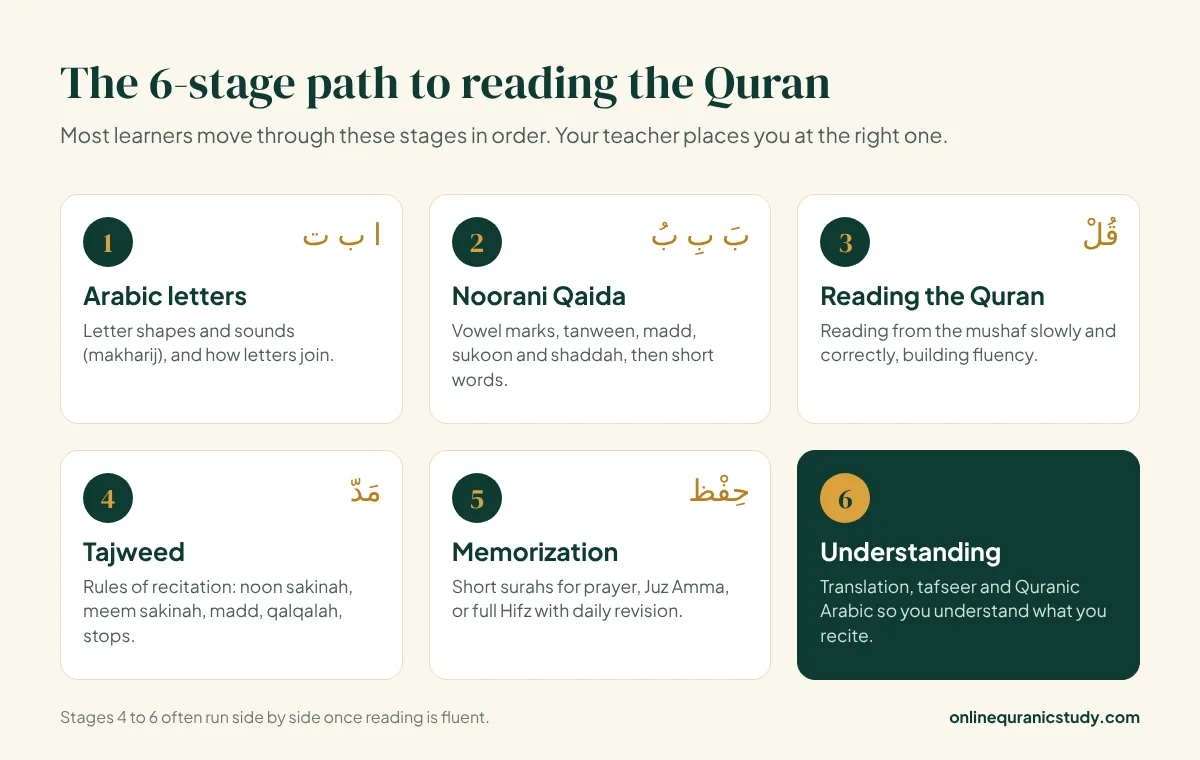
The full journey usually follows six stages. The early ones can't be skipped, but stages four to six often run side by side once reading is fluent.
Step 3: Choose how you'll learn
This is where most people go wrong. The question to ask about any method is simple: will someone hear me recite and correct my mistakes? Arabic has sounds that don't exist in English, such as the throat letters ع and ح, or the heavy letters ص and ط, and several letters that sound alike to an English speaker change a word's meaning if mixed up. You can't hear your own mistakes in a sound you've never learned to make. (Our Quran pronunciation guide explains where each letter comes from.)
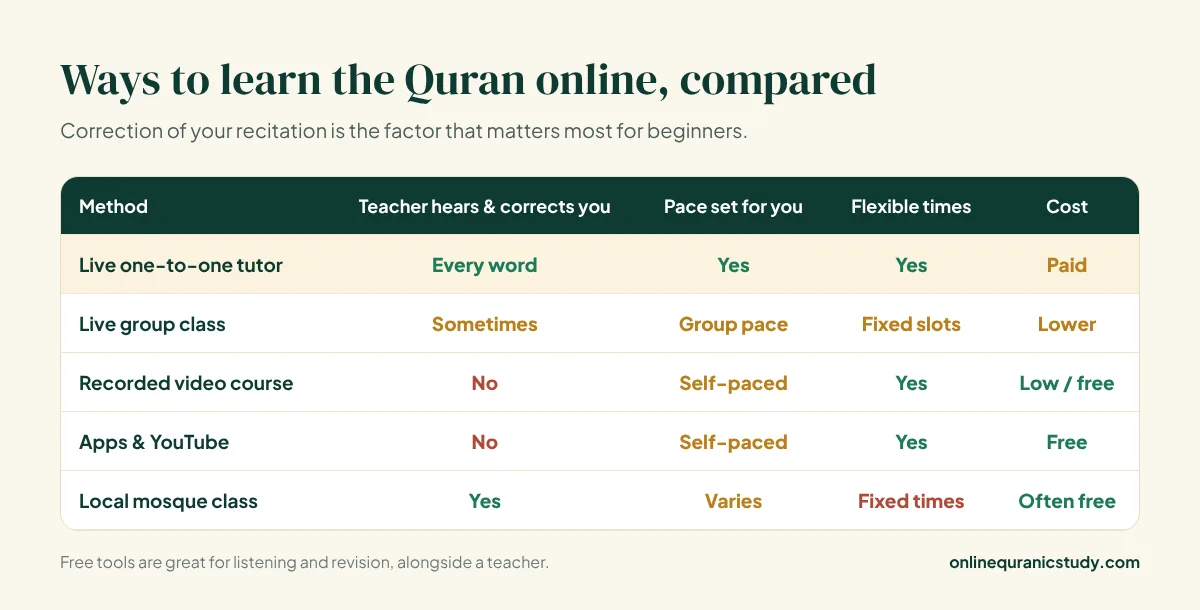
In short: a live one-to-one tutor is the most effective option for beginners, children and anyone fixing old mistakes, because the whole lesson is about you. Group classes cost less but each student reads for less time. Recorded courses, apps and YouTube are excellent for listening, learning theory and revision, but they can't hear you. A good local mosque class gives real correction, if one exists near you at a time you can attend.
Step 4: Choose the right teacher
The teacher matters more than the platform. Before you commit, check:
- Their own recitation. Ask them to recite a passage. It should be clear, correct and unhurried.
- Their training. Ask where they studied and whether they hold an ijazah or Tajweed qualification, and how they teach children versus adults.
- Whether they correct you. In a trial lesson, a good teacher stops you on mistakes politely and makes you repeat, rather than letting you read on.
- Clear English (or your language), so instructions and explanations make sense.
- Male or female. Many families prefer female Quran teachers for girls, sisters and young children; make sure the academy offers the choice.
- Time zone fit. Lessons must fit after school or work in your local time, not just in the teacher's.
We've written a fuller checklist in how to choose an online Quran teacher, and you can meet the people who teach with us on our tutors page.
Step 5: Take a trial lesson before you pay
A trial is the only real test. Use it to check three things: did the teacher assess your level properly, did they correct you, and did you (or your child) enjoy it? Ask the teacher to tell you plainly where you should start and how many lessons a week they'd recommend. At Online Quranic Study the free trial is three days with no payment details needed, so you can judge the teacher over more than one lesson.
Step 6: Set a weekly routine you can actually keep
Most progress happens between lessons. A short daily habit beats a long weekend session, because reading skills fade quickly when they aren't used. Two to five live lessons a week, plus 10 to 15 minutes of practice on the other days, works for most learners:
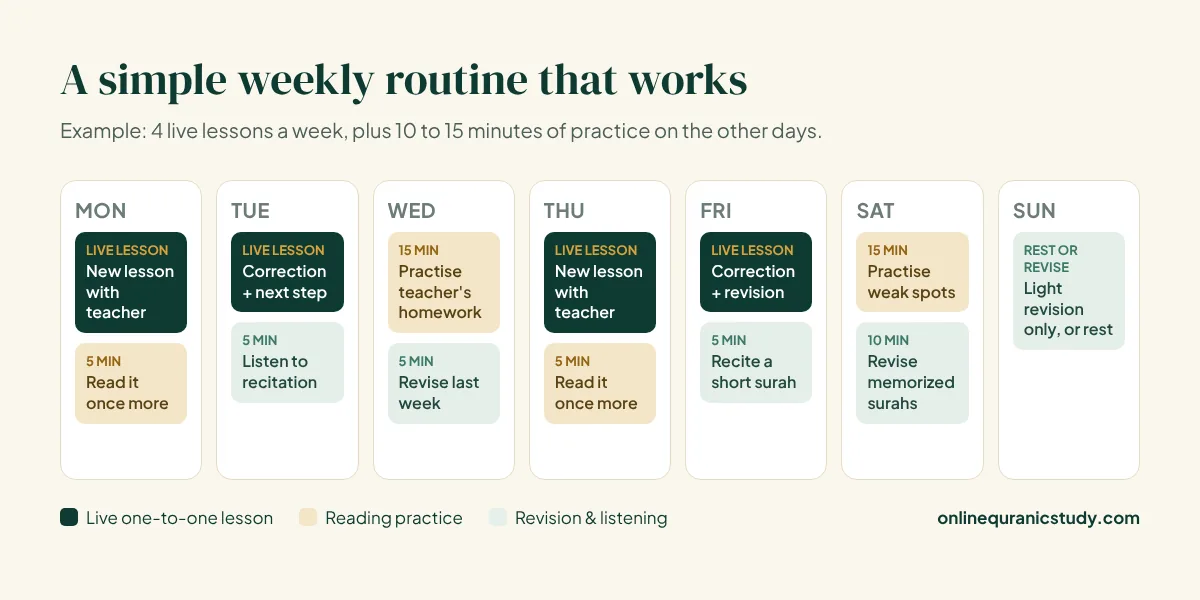
Young children do best with shorter, more frequent lessons (around 30 minutes); adults and Hifz students usually benefit from 45 to 60 minutes. Our guide to building a Quran routine at home has practical tips for families, and the pricing page shows how plans map to lessons per week.
Step 7: Track progress and move up at the right time
Ask for regular feedback in writing, so you can see what's been covered and what still needs work. Signs you're ready to move on: you read the current material without the teacher prompting you, mistakes are rare and you fix them yourself, and earlier lessons still feel easy. Don't rush to finish the Qaida; a solid Qaida makes everything after it faster. Once you read fluently, decide your next goal: Tajweed, memorization, or understanding the meaning.
The best way to learn for kids, adults, beginners and reverts
How kids learn Quran online
Children learn best in short, lively lessons with plenty of praise and repetition. Many begin structured reading at about four to six years old, once they can focus for 15 to 30 minutes (see what age a child should start learning the Quran). Choose one-to-one teaching so every sound is heard, sit in on the first few lessons, and keep the device in a shared room. Our online Quran classes for kids use 30-minute lessons on the Basic plan for exactly this reason.
How adults learn to read the Quran
Adults often feel embarrassed to start, but they tend to move through the beginner stages faster than children because they concentrate longer and understand explanations of why a rule applies. The biggest challenge is unlearning habits picked up from transliteration or from reading without correction. A private lesson removes the embarrassment of reading in front of others. See our online Quran classes for adults for evening and weekend slots.
How beginners learn Quran online from zero
If you can't yet read a single letter, start at the very beginning with the alphabet and the Noorani Qaida. It teaches letter shapes, how letters join, vowel signs and the basic rules in a fixed order, so nothing is left out. Expect the first weeks to feel slow; that is normal and it pays off. Our Quran classes for beginners start exactly here.
How reverts can learn Quran online
New Muslims usually have a more urgent first goal: reciting Al-Fatiha and a few short surahs correctly in salah. A good teacher will teach these alongside the alphabet, so you can pray with confidence while building proper reading skills. Transliteration can help for the first few weeks, but move to the Arabic script as soon as you can, because Latin letters can't show many Arabic sounds. A patient one-to-one teacher, and a female teacher for sisters who prefer one, makes a real difference here.
Can you learn the Quran online for free?
You can learn a lot for free, and you should use free resources whatever else you do. Free options include recitation audio from well-known reciters, Quran apps with word-by-word translation, YouTube Tajweed lessons, printable Noorani Qaida books, and volunteer-run classes at some mosques and Islamic centres. These are ideal for listening, revision and learning the theory of Tajweed.
The limit is correction. A free app can't hear that your ح sounds like an English "h", or that you're shortening a madd (see our guide to the madd letters). If you're learning to read for the first time, or you've never had your recitation checked, a teacher is the part worth paying for. Combine both: free tools for daily listening, and a live teacher to correct you. A free trial lets you see the difference before spending anything.
How to learn the Quran faster without cutting corners
- Increase frequency, not session length. Four 30-minute lessons a week beat one two-hour lesson.
- Practise the same day as your lesson, while the corrections are fresh.
- Listen daily to a clear, slow reciter reading the passage you're learning, then copy them.
- Revise before moving on. Five minutes of earlier material in every practice session stops skills fading.
- Record yourself once a week and compare with a reciter. You'll start hearing your own mistakes.
- Don't skip the Qaida. Learners who rush it are the ones who stall later.
How long it takes depends on age, lessons per week and practice. As a rough guide, many children complete the Noorani Qaida in several months with regular lessons, and adults are often faster. Fluent reading follows with continued practice. Anyone promising a fixed number of weeks for everyone is guessing.
How to learn Quranic Arabic
Reading the Quran and understanding its Arabic are two different skills. Once you read fluently, Quranic Arabic is the natural next step. A practical order is: learn the most frequent Quranic words first (a relatively small set of words makes up a large share of the text), then basic grammar such as pronouns, verb patterns and common particles, and then read short surahs you already know with word-by-word meaning. You'll be surprised how quickly the prayers you recite every day start to make sense. Our Quranic Arabic course and Tafseer classes follow this approach.
Common mistakes to avoid
- Learning only from apps or videos when you've never had your recitation checked.
- Relying on transliteration for months instead of learning the Arabic script.
- Rushing the Qaida to "get to the Quran" sooner.
- Irregular lessons: stopping for weeks at a time and restarting from scratch.
- Choosing on price alone without hearing the teacher recite.
- Moving to Hifz before reading is accurate, which memorizes mistakes along with the words.
Frequently asked questions
What is the best way to learn Quran online?
Live one-to-one lessons with a qualified teacher who hears and corrects your recitation, starting with the Noorani Qaida if you are a beginner, with two to five lessons a week and short daily practice. Use free apps and recitation audio for listening and revision alongside the teacher.
Can I learn Quran online by myself?
You can learn the theory and listen to recitation by yourself, but it is very hard to correct your own pronunciation in sounds you have never been taught. For reading the Quran correctly, a teacher who listens to you is strongly recommended, at least at the start.
Is online Quran learning as effective as learning in a mosque?
Yes, when lessons are live and the teacher corrects you. One-to-one online lessons often give each student more reading time and correction than a large group class. Regular attendance and practice between lessons matter in both settings.
How long does it take to learn to read the Quran online?
It depends on age, how many lessons you take each week and how much you practise. Many children complete the Noorani Qaida in several months with regular lessons, and adults are often faster. Fluent reading follows with continued practice.
How many Quran classes a week should I take?
Two lessons a week suits young children and busy beginners; four to five lessons a week gives faster progress and suits Tajweed and Hifz students. Short practice on the days without a lesson makes the biggest difference.
Can adults learn to read the Quran from zero?
Yes. Adults start from the Arabic alphabet every day and often progress faster than children because they can focus for longer. Private one-to-one lessons avoid the embarrassment some adults feel about starting late.
How can reverts start learning the Quran?
Start with the Arabic letters and, at the same time, learn Al-Fatiha and a few short surahs correctly for prayer with a patient teacher. Move from transliteration to the Arabic script as soon as possible.
Can I learn Quran online for free?
Free apps, recitation audio, YouTube lessons and printable Qaida books are useful for listening, revision and theory. They cannot correct your recitation, so most learners combine free resources with a live teacher. Online Quranic Study offers a free 3-day trial.
Do I need to learn Arabic before learning the Quran?
No. You can learn to read the Quran correctly without speaking Arabic. Understanding the meaning is a separate step, through translation, Tafseer or a Quranic Arabic course, usually started once reading is fluent.
Is "Quranic" a word?
Yes. "Quranic" (also spelled "Qur'anic" or "Koranic") is an adjective meaning relating to the Quran, as in Quranic Arabic or Quranic studies.
Your next step
If you've read this far, you already know more about how to learn the Quran online than most people who start. The next step is simply to begin: choose your goal, find a teacher who will correct you, and keep a small daily habit. The Prophet ﷺ said, "The best of you are those who learn the Quran and teach it" (Sahih al-Bukhari).